

Start here

If I've just sheepishly told you, "Yeah, I've got this blog," this intro should give you a proper jumping-off point into my messy brain-dump.

I am accidentally a journalist.
I did not grow up dreaming about this work. I never took a journalism class. I found my way into my first newspaper job mostly through happenstance, then left the field for a while and worked in the outdoor industry, and then marketing and technology, before journalism called me back.
That has always left me feeling a little like a tourist in the field. I know the work from the inside, but I have never quite felt acculturated to all of its assumptions. Some days that feels like impostor syndrome. Other days, I wonder if it is the thing that helps me notice what I notice.
The questions I am working through here come from two decades in and around news, media, technology, and local journalism. More specifically, they come from my work in Kalamazoo, where I've been helping build NowKalamazoo and the Local Journalism Foundation around a simple but stubborn idea: local journalism should not only produce information. It should help people become more informed, connected, confident, and capable participants in local life.
One of the questions that has followed me for years is what happens after journalism moves someone.
Good journalism can anger people, orient them, unsettle them, inspire them, make them want to act, give, join, learn more, or do any number of things. But the field has not always been very good at helping people understand where to put that energy. We often produce awareness without pathways. Feeling without direction. Concern without agency. If you ask me why or how this has happened, I suspect a big reason is that we've over-indexed on "objectivity," and our fear of being perceived as "advocating" for anything has led us to extreme un-helpfulness.
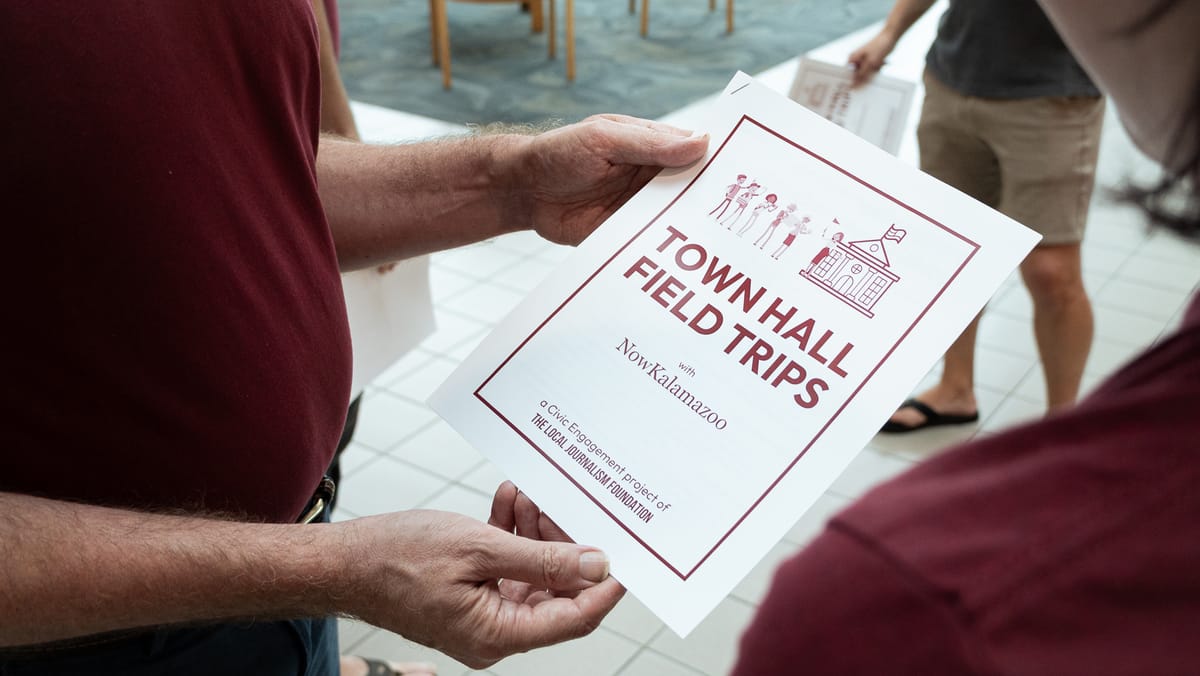
This "what happens after" question led NowKalamazoo to experiment with work that does not always look like traditional journalism: guided adult field trips to local government meetings, film screenings, workshops on public records, voter forums where the point is not to hear from candidates but to hear from one another.
Those experiments brought me to the question at the center of this fellowship and this blog.
The question
During my Knight-Wallace Fellowship, I am studying why people seek, use, value, avoid, ignore, or support local journalism, and what news organizations might do to strengthen the conditions that make journalism matter.
The shorthand version is this:
What if local journalism’s crisis is not only a supply problem?
The field has spent decades trying to produce better journalism, new formats, better products, distribute on more platforms, in newsletters, with different business models, and better technology. Much of that work matters. But it often assumes demand is already there, waiting to be captured if we can just find the right product.
I am not sure that is true.
My suspicion is that demand for local journalism is socially produced – as much or more than it is intrinsically inherent in people. It depends on things outside journalism itself: trust, belonging, civic confidence, social connection, institutional experience, practical usefulness, and whether people believe public life has anything to do with them.
That raises a harder question:
What has to be true in a community for local journalism to matter to most people? What conditions must be present for even a chance at sustaining the type of business we want to be operating, that allows us to do the work we're aching to do?
What the fellowship is for
This fellowship gives me nine months to step partly outside the daily demands of running a local news organization and test that question more seriously.
To some people, the fellowship might seem like a detour from the mission I'm already on, but I think it's critically necessary. I am using it as a container for a public inquiry: reading, studying, interviewing, listening, writing, and trying to turn a set of intuitions from practice into a framework that could be useful to other local news organizations.
I want to know whether it is possible to build demand for local journalism by investing in the civic conditions that make people more likely to seek information, trust it enough to use it, and feel capable of acting on it.
That may be wrong. Or incomplete. Or obvious in some other fields and strangely underdeveloped in journalism. Part of the point of the next nine months is to find out.
What I mean by demand
By "demand," I do not mean clicks, traffic, audience growth, or giving people whatever content they say they want.
By demand, I mean something deeper: the felt need for journalism and civic media. The perception that local news is useful, trustworthy, relevant, and worth making room for in your life.
Demand is what makes people seek information before someone has to chase them with it. It is what makes a local news organization feel like civic infrastructure rather than just another content source. It is the opposite of avoidance.
There was a time when many (most?) people treated local news as part of the ordinary machinery of living in a place. They subscribed when they moved to town. They made daily or weekly appointments with the news. They expected the newspaper, the radio station, and the TV crew to be present at community rituals, public meetings, emergencies, games, openings, disputes, and celebrations.
I am not interested in romanticizing that past. Plenty about it was exclusionary and incomplete. People have been harmed by journalism. But I am interested in understanding what conditions made journalism feel necessary, and how to move away from the conditions that make it feel optional, alienating, irrelevant, or even hostile now.
How to read this blog
I do not have the answers, and I am not even sure I have the questions right.
This site is where I will think in public during the fellowship. Some posts will be essays. Some will be field notes. Some will be interviews, sketches, reading notes, arguments, revisions, or attempts to explain an idea before I fully know what I think about it.
Please don't quote any of this as doctrine. I am not telling anyone what to do. I am not claiming to know how to "save journalism." I am not arguing that one form of journalism is pure and another is tainted or unworthy. I am trying to articulate what experience has made me suspect, then test those suspicions with study, conversation, evidence, and practice.
If you are reading months into the project, the archive may look scattered because the inquiry is still unfolding. But the thread running through it is this:
Local journalism might not become more durable by producing more or better journalism. It may also have to help rebuild the civic conditions that make journalism useful in the first place.
Try one of these next
 Reid Williams
 Reid Williams
Discussion